
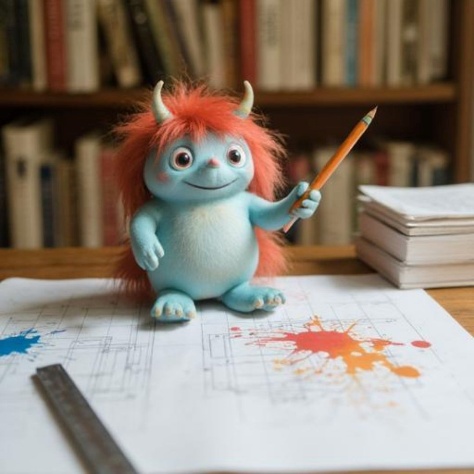
You sit down to write and nothing comes. Or worse, words come, but they’re flat and dutiful, dead on the page, and you can feel it as you type them. We call this writer’s block, and most advice treats it as a wall to be broken down by sheer force—write through it, push harder, plant yourself in the chair until something gives. But it usually isn’t a wall. More often it’s a signal that the part of you that writes the living, surprising, genuinely good material has been caged. And you don’t beat that kind of block by pushing harder. You beat it by letting that part of you off the leash.
Every time you sit down to write, two very different collaborators show up with you. One arrives with a blueprint, a calendar, and strong opinions about what a chapter is supposed to do. The other slinks in without explanation, drops something strange and wonderful on the page, and disappears before you can ask it a single question. Most of the frustration writers feel—blank pages, dead drafts, outlines that suffocate, freewriting that sprawls into nowhere—comes from not understanding three things:
- both collaborators are necessary
- they want completely different things
- when you’re stuck, one of them is almost always starving
This article is mostly about the second collaborator, the one you’ve probably never been formally introduced to even though it’s been doing your best writing all along.
Meet Your Creative Monster
The second collaborator is harder to describe because it refuses to explain itself. It’s the source of voice, the particular music of your sentences that no outline could have predicted—your unique creativity named. It’s where the surprising image comes from, where a walk-on character abruptly takes over a scene, where you write a line and think, I didn’t know I knew that. It works by association, not logic, and it almost never works on command. It often does its best thinking when you’re not at the desk at all, but in the shower, on a drive, in the drifting minutes before sleep. Psychologists call this incubation, and it isn’t laziness. It’s creativity idling in the background while you do the dishes.
It’s tempting to call this a muse, but “muse” is too gentle. It’s more useful to think of it as a monster—hungry, willful, occasionally feral, and absolutely the source of everything that makes a book feel alive instead of assembled. This is your creative monster, and most writers go their whole lives without realizing it’s a distinct part of them, with needs of its own. Once you do, how you deal with feeling stuck changes.
Like any monster, it has demands.
It needs to be fed. Reading, resting, exploring a range of creative outlets, paying real attention to the world is the raw material it digests. Starve it, and it goes silent.
It needs room to roam. Its gift is surprise, and surprise cannot be scheduled into a 9 a.m. slot or itemized in advance on an outline.
It distrusts the cage. Hand it a rigid, beat-by-beat plan with every turn dictated ahead of time, and it sulks. The prose that comes out is dutiful and dead because you’re no longer discovering the story. You’re transcribing one you already finished in spreadsheet form.
Keep that last one in mind, because a caged monster is the single most common reason good writers freeze.
The Architect: Your Other Collaborator
Before we let the monster loose, it’s worth meeting the one holding the leash. The conscious mind is the part of you that knows the rules. Structure, cause and effect, the difference between a scene that earns its place and one that’s just marking time is its territory. It is deliberate, sequential, and disciplined, and it asks the useful, slightly anxious questions: Where is this going? What does this chapter accomplish? Why would a reader keep turning pages?
This is the architect. It plans, it evaluates, it revises. It is also, left entirely on its own, a terrible novelist, because everything it produces is correct and almost nothing it produces is uniquely creative. The architect can build a structurally flawless house that no one wants to live in.
You need it anyway. A monster left completely off the leash forever doesn’t write a novel either. It wanders, producing two hundred thousand words, six abandoned subplots, and no plot spine. The monster doesn’t care about the reader; that’s the architect’s job. So this isn’t a story about freeing the monster and banishing the architect. It’s about knowing which one is starving when you’re stuck so you can feed the right one.
Why You’re Really Blocked
Here’s the trap most writers fall into, and it usually splits along familiar lines. Plotters trust the architect and quietly cage the monster, then wonder why their technically sound manuscripts feel lifeless. Pantsers trust the monster and starve the architect, then drown in a draft full of energy but no shape. Both camps get stuck for the same underlying reason: they picked a side in a fight that was never supposed to be in opposition to begin with.
In practice, the caged monster is the version writers meet most often. You’ve planned the scene to death, you know exactly what’s supposed to happen, and that’s precisely the problem. There’s nothing left to discover, so there’s nothing pulling you forward. The block feels like emptiness or dread, and no amount of discipline fills it because discipline is the architect’s tool, and the architect isn’t the one who’s hungry.
The opposite is when you’ve under-planned and the draft has turned to chaos, because the monster has been running loose with no walls to push against, so you’re lost. That one feels like flailing rather than dread, and the cure is the reverse—let the architect work on the blueprint, find the spine, decide where the load-bearing walls go. But if your writing feels dead rather than chaotic, the diagnosis is almost always a caged monster. And the cure…
Letting the Monster Off the Leash
Taking the leash off doesn’t mean abandoning structure forever. It means, in the moment you’re stuck, deliberately handing control back to the part of you that creates without permission. And it works in two directions that writers often confuse, because sometimes the monster needs to run and sometimes it needs to rest.
Sometimes off the leash means writing wild. Generate first and judge later. When you’re drafting, let the monster loose and forbid the architect from interrupting. No editing, no second-guessing, just forward motion. Trying to create and evaluate in the same breath jams the gears, which is exactly why drafting and line editing at the same time grinds so many writers to a halt. Concretely: give yourself explicit permission to write the wrong version, the bad version, the version no one will ever see. Free write straight past the blocked spot. Ask a question you genuinely don’t know the answer to—“what does she want, and what is she willing to lose to get it?”—and let the monster chase it. Open a door in your outline and let a scene wander somewhere it wasn’t supposed to go. Almost anything that removes the pressure to be correct will coax the monster back out.
And sometimes off the leash means stepping away from the desk entirely. This is the part driven writers resist hardest, so it bears saying plainly: forced writing that gives the creative monster no time to process and rest is never a good idea. The monster does some of its most important work when you’re not writing at all—walking, sleeping, staring out a window, doing the dishes. Honor that. Front-load a problem by ending a session on an unsolved question, then walk away on purpose and let incubation do what willpower can’t. A break is not the absence of work. For the monster, it often is the work. Grinding out forced pages on top of an exhausted, unfed monster doesn’t beat the block. It deepens it and teaches you to dread the desk.
The architect gets its turn afterward. Let the monster off the leash to generate or to rest, then bring the architect back on a later pass to shape what came of it.
When You’re Stuck, Ask Which One Is Hungry
Once you start seeing your process this way, writer’s block becomes much easier to diagnose. A stuck writer is almost always starving one of the two collaborators. So before you try to power through, ask which one.
If the work feels lifeless, the monster is caged: give it something to chew on. Open a door in the outline, ask a question you don’t know the answer to, let a scene wander or close the laptop and let it rest until it has something to say.
If the work feels chaotic, the architect has no blueprint: step back, find the spine, and decide where the walls belong.
Give the architect its walls and the monster its open doors, and most of what you’ve been calling writer’s block turns out to be a diagnosis you can act on rather than a wall you have to figure out how to tear down.
Plan So It Doesn’t Cage You Again
Most advice about outlining goes wrong because it frames planning as the conscious mind seizing control. It isn’t, or it shouldn’t be. A good plan is not the architect winning. A good plan is a peace treaty: enough of a blueprint that the structure will hold weight, with enough open space left for your creative monster to do the one thing only it can.
So plan in questions, not just answers. “What does she want, and what is she willing to lose?” feeds the monster; “Chapter 7: confrontation at the lake” closes a door. And mark your exits by building your outline with flagged places where the story is allowed to surprise you, so that when the monster wants to take a turn you didn’t plan, there’s already a door standing open. Those unfurnished rooms aren’t failures of planning. They’re invitations. Experienced novelists don’t plan more or less than beginners—they plan smarter, leaving strategic gaps exactly where discovery is supposed to happen, which is also exactly how you keep from caging the monster in the first place.
So the next time the page goes dead, don’t reach for more discipline. Take the leash off. Write the wrong version on purpose, or shut the laptop and go for a walk, let your creative monster remember why it loves writing.