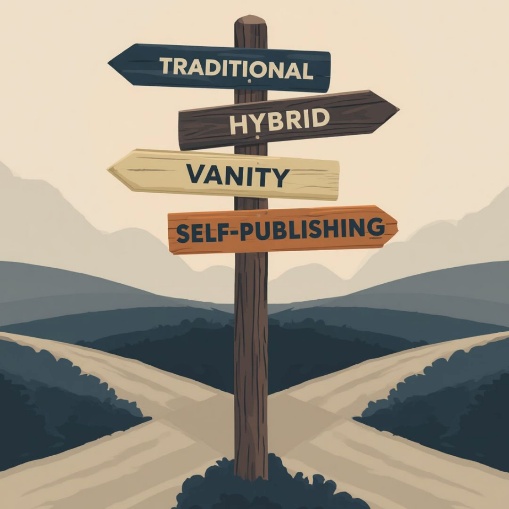
If you’ve started looking into how to publish your book, you’ve probably noticed that everyone has an opinion and most of them are selling something. The truth without the sales pitch: There are four paths to publishing, each with real advantages and costs, and none of them is simply “best.” The right one depends entirely on your goals, your budget, your timeline, and how much control you want to keep. Here’s an honest map, including the trade-offs most opinion pieces tend to gloss over.
Traditional Publishing
In traditional publishing, a publisher buys the right to publish your book, pays you an advance against future royalties, and covers the costs of design, printing, and distribution. When it works, it’s a genuine partnership backed by real resources and industry credibility. The catch is getting in.
First, the manuscript has to be polished to a professional standard before you query. That means months of revision, a query letter, a synopsis, comp research, and a contact list built by hand, then hundreds of queries sent in hopes of a few interested replies. The cost here is mostly time, and it’s substantial.
Second, traditional publishing is heavily gatekept. You usually need a literary agent first, then a publisher, and the odds at each gate are low. It’s also slow (normally 1–2 years from deal to shelf), you give up most of your rights and creative control, and even signed authors are increasingly expected to do much of their own marketing.
If you land an offer from a traditional publisher that fits your goals, it’s a strong path. Most manuscripts never get the chance.
DIY Self-Publishing
At the other extreme, you can do everything yourself. Hire your own editor and designer (or don’t), format the files, set up the accounts, manage distribution, and keep every penny of the royalties. The appeal is total control and the highest margin per book.
The cost is that you are now the publisher, with all the responsibility that implies. Every stage—editing, design, formatting, distribution—has its own learning curve, and the professional versions aren’t cheap: editing a full-length manuscript typically runs into the thousands of dollars, with a professional cover adding hundreds more.
Done well, DIY produces books indistinguishable from any other on the shelf. Done without experience or professional support, it produces books that gave self-publishing its old reputation: rough covers, awkward interiors, error-strewn text. Done with patience, a real budget, and the humility to hire professionals where it counts, it’s a legitimate path.
Vanity Presses
This is the path to walk away from, and it’s worth being blunt about why. A vanity press takes your money to produce your book, often takes your rights along with it, and wraps the whole thing in flattery and big promises. They accept essentially everyone, because they are selling services to authors and books to the author’s family and friends, then moving on to the next sale.
They present as self-publishing service providers, publishers, and hybrid publishers but are referred to as vanity presses because they prey on authors wanting to share their book with the world at large, using targeted feel-good language. And they come and go rather frequently—once bad reviews accumulate to the extent of slowing down sales leads, they simply shut down and reopen under a new name. The warning signs travel together: lavish praise, vague pricing, evasive answers about rights.
Hybrid Publishing
Hybrid is meant to be the sweet spot—professional publishing combined with author independence. In a legitimate hybrid arrangement, you invest in production and work with a vetted, professional team; you keep your rights and royalties; and the publisher is genuinely selective about what they take on. That selectivity is the whole point: When a publisher’s name actually means something, they can’t afford to put it on just anything.
The problem is that hybrid is the most counterfeited label in publishing. Because it sounds respectable, plenty of vanity presses have simply rebranded as hybrids without changing anything underneath. So the label tells you almost nothing on its own. What matters is what’s behind it.
- Is the publisher selective, or do they take everyone with a checkbook?
- Is the pricing transparent and all-inclusive, or does it keep shifting?
- Do you keep your rights and royalties?
- Is the contract written in plain language you can actually understand?
- Are they honest about what’s realistic, or are they promising you the moon?
A legitimate hybrid answers all five without flinching, in writing, before money changes hands. There’s an independent benchmark too: the Independent Book Publishers Association publishes an eleven-point Hybrid Publisher Criteria defining what a real hybrid is, and by IBPA’s own standard, a publisher that can’t meet every point isn’t a hybrid—no matter what its website says. Ask any publisher you’re considering to walk you through the list. The good ones won’t mind.
So Which One Is Right?
There’s no universal answer, and anyone who gives you one without asking about your situation is selling, not advising. If you have the patience and connections for traditional publishing and your goals fit that path, pursue it. If you want total control and are willing to become a publisher, DIY can be excellent. If you want professional results with your independence intact, a genuine hybrid is worth a serious look, provided you’ve checked it against the questions above. And if a publisher accepts everyone, won’t be straight with you about money or rights, and showers you with flattery, you’ve found a vanity press, no matter what it calls itself.
Whatever path you choose, be certain about what you’re trading away. Every path costs something—money, time, control, or all three—and the authors who end up happiest are the ones who decided with their eyes open.