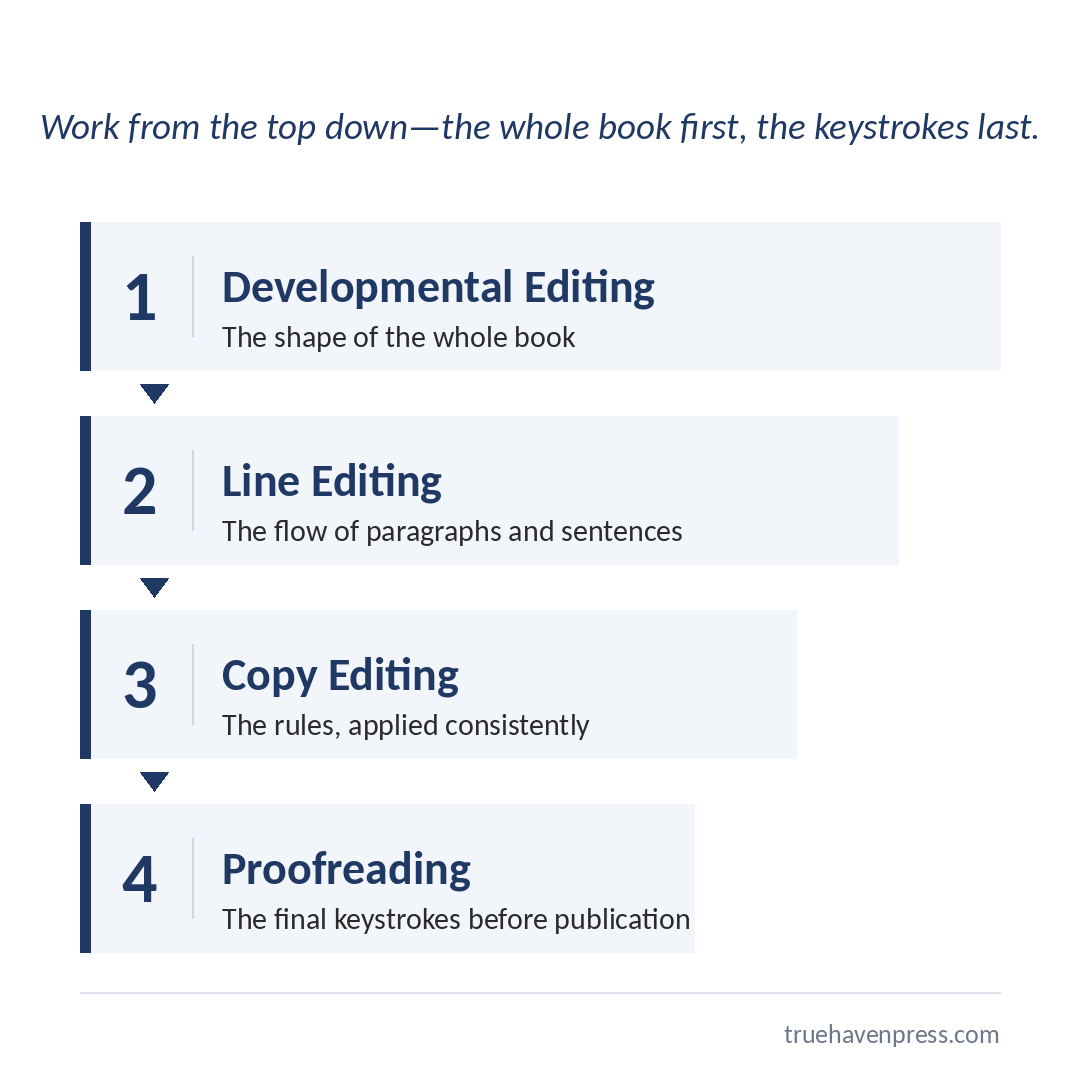
People often refer to “editing” as if it’s one service. It isn’t. It’s a sequence of different kinds of work, each addressing a different level of the book, and they’re meant to happen in a particular order. Authors who don’t know the difference spend money in the wrong place, like paying for a proofread when the structure still needs work, or asking for a deep developmental edit when the manuscript is already strong and just needs polish.
The cardinal rule is to work from the top down: the shape of the whole book first, then the flow of paragraphs and sentences, then the correctness of the keystrokes on the page. There’s no sense in polishing a sentence that might be deleted by a structural edit, and no point in proofreading commas in a chapter that hasn’t finished finding its form. And where your manuscript enters that sequence shouldn’t be a guess—it should be a diagnosis made through collaboration with a professional who’s actually read your pages.
Here’s what each kind of editing actually does, so you can spend your budget where it will count.
Developmental Editing
Developmental Editing is the big-picture work—the deepest and most transformative layer. It takes a manuscript from rough draft toward a complete, structurally sound first draft, and it asks the largest question there is: Does this book actually work?
What that means depends on what you’re writing. In a novel, it’s about story: Is the central conflict clear and compelling, does the plot rise and fall at the right pace, do the characters behave consistently and grow believably, does the point of view hold without head-hopping, does the ending earn itself? In a nonfiction book, it’s about whether the book delivers on its promise: Does each paragraph build toward the point of its section, each section toward the promise of its chapter, and each chapter toward the promise of the title—so a reader comes away genuinely taught, persuaded, or changed? Different questions, same purpose: make sure the foundation is sound before anyone fusses over the details.
A developmental edit at True Haven Press also comes with a written report—a synopsis of where the manuscript stands, its real strengths, its areas of opportunity, and guidance tied to specific moments in the text. You’re not just told what to change. You’re shown how and why. And if budget is tight, a Critique applies the same experienced eyes at lower cost to your first 30–50 pages—pointing out the patterns, teaching the fixes—so you can carry the lessons through the rest of the manuscript yourself.
Line Editing
Once the structure is sound, Line Editing fine-tunes the writing paragraph by paragraph and sentence by sentence, with most of the work delivered as inline suggestions in your manuscript. The goal is to make the prose do what you intended while keeping your voice unmistakably yours.
For fiction, that means tightening pacing and rhythm, sharpening dialogue, converting flat exposition into scenes a reader can feel, smoothing point-of-view transitions, and cutting the clichés, repetition, and overexplaining that dull a story. For nonfiction, it means making sure the argument flows in the order most beneficial for the reader, that examples and stories land where they’ll do the most good, that nothing essential is missing and nothing redundant remains, and that the chapters transition smoothly. In both, it’s the difference between prose that’s merely correct and prose that’s a pleasure to read.
Copy Editing
Copy Editing is rule-based precision: grammar, word choice, sentence mechanics, paragraphing, and, above all, consistency—that your spelling, hyphenation, capitalization, and facts hold steady from the first page to the last, in strict accordance with the style guide you choose. Line Editing includes this work; the standalone option exists so that when correctness is all you need, correctness is all you pay for.
Proofreading
Proofreading is the final safety net, the last read before publication. It catches what survives every earlier pass, like stray typos, missing periods, letters that should be capitalized. It focuses at the level of individual words and keystrokes and is strictly rule-based, measured against the Chicago Manual of Style and the Merriam-Webster Unabridged Dictionary. Proofreading isn’t where a book gets better—it’s where a finished book gets clean.
Which Type of Editing Do You Need?
A rough or uncertain manuscript—or an author who wants to learn to self-edit—starts with a Developmental Edit or a Critique. A complete, structurally solid draft that still reads a little clunky should get a Line Edit. Prose that’s already strong but needs its mechanics squared away needs a Copy Edit. And every book, no matter how clean, deserves a final Proofread before it meets a reader.
Still not sure where your manuscript falls? You don’t have to figure that out by yourself or blindly trust someone you don’t know to diagnose it for you, and it shouldn’t cost you anything to find out.
Submit your manuscript, and we’ll return three things:
- a sample edit in your actual pages
- a detailed assessment report on where the writing stands
- a proposal for the editing it genuinely needs
No guesswork, no upselling, no paying to polish a sentence that should have been cut.